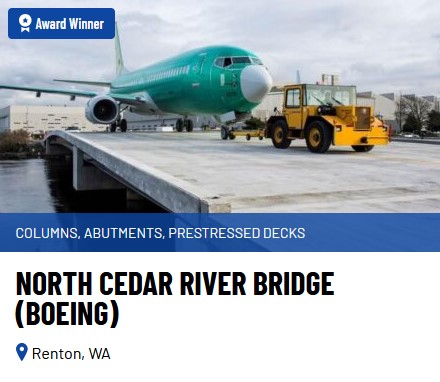
Thomas Fountain, Executive Vice President of Concrete Technology Corp. (CTC), sat down with RTC Foundation Executive Director, Carrie Shaw, to talk about the company’s vision around workforce development and their partnership with community and technical colleges to increase the number of students who certify advanced skills in manufacturing.
The Tacoma-based company has started funding grants for welding students to take what is called the WABO certification. Costs can be a barrier for students to access the testing which increases their job placement and salary levels.
Q: What is your industry’s most pressing workforce needs?
Our most challenging workforce need in manufacturing is overcoming the critical, widening skills gap, specifically in finding, training, and retaining workers proficient in manufacturing technologies.
Q: What has been your education/career journey and what led you to Concrete Technology?
My educational and career journey has been shaped by a strong commitment to learning, teaching, and industry. I began my academic path at Lower Columbia Community College with an interest in law and criminal justice. I later transferred to the University of Idaho, where I pursued and earned a Bachelor of Science degree in Agricultural Mechanical Systems and Biology.
Following graduation, I entered the field of education, earning an MED degree in Ed Admin and taught metal fabrication and automated systems manufacturing at both the secondary and community college levels. Over the course of 27 years in public education, I focused on preparing students for successful careers in industry, emphasizing technical skill development, problem-solving, and workforce readiness.
After nearly three decades in the public education system, I made the decision to pivot into industry. Joining CTC was a natural transition, as the company is deeply rooted in my family’s history. As a third-generation family-owned business, CTC represents both a continuation of our legacy and an opportunity to apply my educational and technical experience in a new and meaningful way.
Q: Why did you reach out to the RTC Foundation and are you partnering with other technical colleges?
CTC reached out to Renton Technical College to support technical programs that prepare students to enter the skilled trades. Technical trades are often underemphasized in traditional academic pathways, yet they are essential to creating, developing, and maintaining our economy. These fields play a critical role in sustaining national infrastructure and ensuring international competitiveness.
We are actively partnering with numerous community colleges and universities around the Puget Sound region.
Q: What has been your favorite outcome or result so far with the RTC Foundation partnership around WABO grants?
CTC’s most valued outcome of supporting the WABO grants is seeing them actively utilized by students. Their use demonstrates that Renton Technical College is effectively developing students’ skills and that students recognize the value of earning industry-standard certifications.
We believe in investing where there is a return. Students who work hard, remain committed, and overcome adversity deserve support from industry. These students represent a high return on investment, and they form the future backbone of our local, regional and national workforce.
Q: What would you tell an RTC graduate about career mobility and opportunities with Concrete Technology?
 CTC is a great company to work for, offering a diverse range of labor, technical,
and engineering career opportunities. Our workforce includes approximately 170 members
of Local 252 Laborers’ Union and 60 administrative staff.
CTC is a great company to work for, offering a diverse range of labor, technical,
and engineering career opportunities. Our workforce includes approximately 170 members
of Local 252 Laborers’ Union and 60 administrative staff.
Union employees receive competitive pay, excellent benefits, access to a robust technical training program, and opportunities for vertical advancement. At CTC, we do not seek to simply fill jobs—we are committed to developing long-term careers.
Summary of Company’s History:
In 1951, Thomas and Arthur Anderson established the first prestressed concrete manufacturing facility in the country. Their modest four-employee company hinged on belief in a novel technology that they believed would transform the US construction industry.
Through extensive research, development, and promotion, the Andersons successfully championed this revolutionary construction material for use in bridges, buildings, and marine structures. Their tireless efforts put CTC on the international map and established prestressed concrete as a material of choice.
Seven decades later, CTC continues its founders’ legacy of innovation and excellence. From record-length concrete bridge girders to floating concrete structures, CTC remains a leader in the precast/prestressed concrete industry.
Learn more about CTC's history.